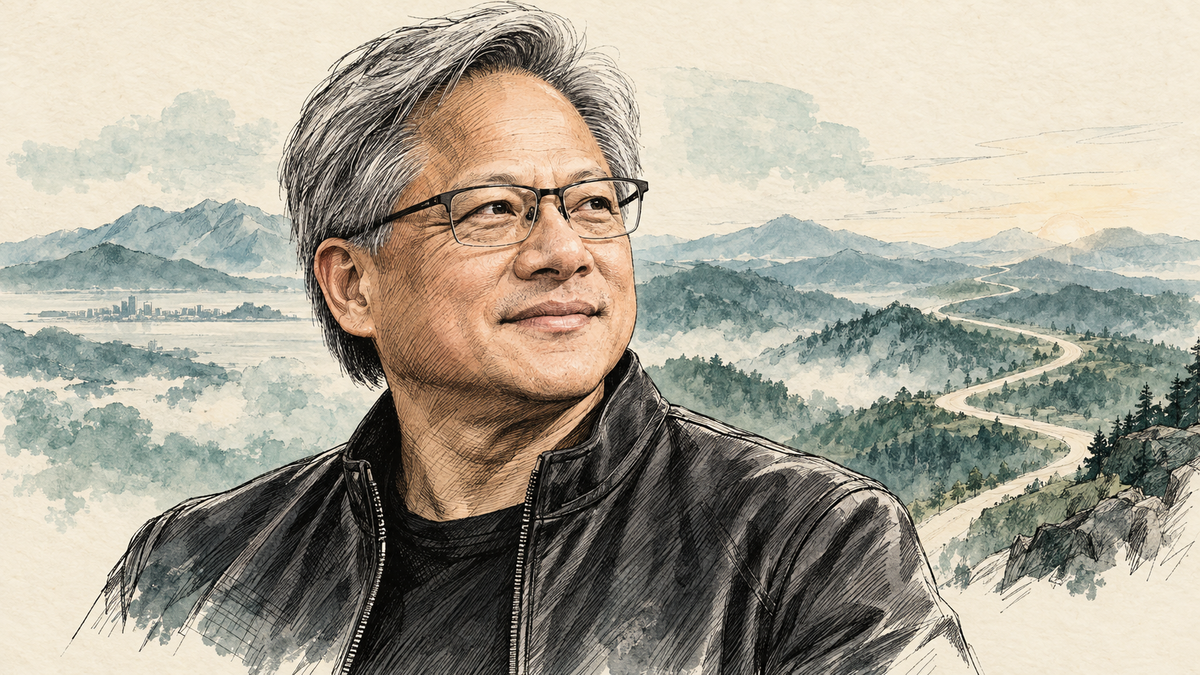
Jensen Huang's story is often told backward. Start with the AI boom, point to the man in the leather jacket, then arrange three decades of decisions into a straight line toward the present. The ending makes the beginning look inevitable.
It was not.
The more useful story begins with a child sent across the world, an engineer learning inside other people's companies, and a young business that discovered its first technical direction could lead it out of the market it wanted to serve. It continues through years of building software around processors before the biggest commercial reward was visible. The common thread is not perfect foresight. It is the ability to stay in the game while changing what the game requires.
That is what makes Huang worth studying beyond the headlines. Longevity gives effort time to compound. But years alone do not compound into an advantage. Something useful has to survive from one period to the next: knowledge, trusted relationships, working tools, a community of developers, and the capacity to admit that a particular answer is wrong without abandoning the larger question.
NVIDIA's history contains all of those things. A founder's conviction is not proof that every customer will earn a return. The useful story examines how the capability was built, what it cost to keep learning, and why the years mattered.
Before the company, there was dislocation
Huang was born in Taiwan. His childhood took him through Thailand and then to the United States. Carnegie's account describes his parents sending him and his brother to an uncle in Washington, followed by his enrollment at the Oneida Baptist Institute in Kentucky. NPR's 2012 reporting gives the story a voice well before Huang became an international symbol of the AI boom. [J1, J2]
In that NPR interview, Huang recalled his parents wanting the children somewhere safer during unrest in Thailand. At Oneida, he encountered a demanding environment. Students worked as well as studied. His job included cleaning bathrooms. He described tough children, made friends, helped an older dorm-mate with mathematics and joined the swim team. [J2]
The detail matters because it resists a polished origin story. This was not a childhood designed as preparation for Silicon Valley. Nor should we pretend to know exactly which later decision came from which early hardship. Biography can show experiences. It cannot run the experiment in which those experiences never happened.
There is another detail worth keeping. Huang told NPR that he loved his time there. That recollection does not erase the difficulty. It makes the experience more human than a simple tale of suffering followed by escape. A hard period can contain work, friendship, fear, pride and affection at the same time. [J2]
His family later reunited in Oregon. Carnegie records that he graduated from high school at sixteen, then studied electrical engineering at Oregon State and earned a master's degree at Stanford. NVIDIA's biography confirms those degrees and his work at AMD and LSI Logic. [J1, J3]
It is tempting to turn this into an instruction: adversity produces greatness. That would be too easy, and unfair to people whose hardship closes doors rather than opening them. The narrower lesson is stronger. Huang's early life required adaptation before adaptation became a business philosophy. The path to opportunity was neither comfortable nor direct.
For readers building a company while feeling behind, that distinction is useful. An unconventional beginning is not evidence that the eventual work is impossible. It is also not a promise that the work will succeed. It is the beginning, not the verdict.
The dishwasher is part of the engineer's story
In his 2024 Stanford Graduate School of Business interview, Huang spoke with pride about working at Denny's. He described organizing the work, washing dishes efficiently and advancing to busboy. His account emphasized not returning empty-handed and not wasting movement. These are his recollections, not a productivity experiment. Stanford also cautions that its lightly edited transcript may contain errors. [J4]
Why does this episode deserve space in a story about computing?
Because the habit it illustrates is smaller and more transferable than the later success. A job can be treated as a title, or as a system to understand. What needs doing? What delays the next person? What can be prepared before the rush? What makes a completed task different from visible activity?
We cannot prove that restaurant work caused NVIDIA's later strategy. We can notice the continuity in Huang's own telling: respect for the work in front of him, attention to how it is organized, and a wish to do it well before it becomes prestigious.
The engineering years added another layer. The Computer History Museum's oral-history summary describes Huang choosing AMD for the opportunity to design microprocessors, then moving to LSI Logic as design tools evolved. His work there brought him into contact with Chris Malachowsky and Curtis Priem at Sun Microsystems. Those relationships eventually became a founding team. [J5]
A company presented as an overnight invention often rests on years spent inside other organizations. That period can look unremarkable in a short biography. Yet it is where technical judgment develops, collaborators learn one another's strengths, and reputation becomes something another person may risk money on.
In the Stanford interview, Huang describes his former LSI leadership helping him reach investor Don Valentine. The lesson is not that every talented engineer will receive an introduction. It is that work done before the startup can become an asset inside it. Trust has a history. [J4]
There is a kind of compounding here that does not appear on a stock chart. Skills make a person useful. Useful work creates relationships. Relationships create chances to attempt harder work. None of the steps guarantees the next. Together, they make an improbable future more reachable.
Three founders and an answer that had to change
NVIDIA dates its founding to April 5, 1993, by Huang, Malachowsky and Priem. The original commercial focus was 3D graphics for gaming and multimedia. The familiar Denny's meetings belong to this history, but the restaurant is not the explanation for what followed. Three people still had to choose a problem, finance an attempt and make something customers could use. [J6]
Graphics provided a concrete starting point. A better image could be seen. A more responsive game could be felt. The technology had an application through which a buyer could recognize improvement.
That did not make the early answer correct. Huang's Stanford account describes NVIDIA's graphics approach becoming incompatible with Microsoft's Direct3D direction. He remembers a company confronted with the need to reset or fail, and turning to published graphics knowledge to learn another way. The museum's oral-history summary likewise describes early missteps and near-death experiences. [J4, J5]
This is the first major paradox in the story: persistence required abandoning work.
Founders are often praised for refusing to give up. But refusal alone is not a strategy. Sometimes the thing that must be given up is precisely the design into which the most pride and effort have gone. The market does not reimburse the hours spent defending an answer it cannot use.
A standard is a commercial fact. A product can be clever and still sit outside the system customers intend to buy. Imagine a retailer acquiring a scanner that reads labels at extraordinary speed but cannot write to the inventory software. Its speed does not repair the missing connection.
Huang's account is valuable because it breaks the illusion that NVIDIA's later platform thinking emerged from never being wrong. We should not claim one mistake caused every later software decision. We can say that the history makes compatibility and the surrounding ecosystem impossible to treat as secondary concerns.
Survival also puts limits on romantic lessons. Many companies recognize a mistake and still cannot fund the correction. NVIDIA's subsequent success should not erase the role of colleagues, investors, customers and circumstances that allowed another attempt. The founder mattered. He was not the only person in the room.
The more useful model is a stable question and revisable answers. How can computing solve problems that existing machines handle poorly? Graphics was one answer. A particular graphics architecture was a narrower answer still. Keeping those levels separate creates room to change the product without losing the purpose.
The second clock
A business runs on at least two clocks.
The short clock measures the next product, the next customer and the money needed to continue. The long clock measures the capabilities that might make the company useful years later. Neglect the first and there may be no company left to enjoy the second. Neglect the second and a successful product can become a shrinking inheritance.
NVIDIA's move beyond graphics is interesting because the two clocks had to coexist. The company kept serving an existing market while making its processors accessible to different forms of computation. CUDA was announced in November 2006. NVIDIA's November 2026 anniversary account describes it as a programming model that opened GPUs to scientists and developers beyond graphics. [J7]
A processor does not create an industry merely by being powerful. Someone must explain how to program it. Someone must build tools, maintain them, teach people, improve the documentation and respond when real users discover what breaks. These tasks can look less dramatic than a chip launch. They are also part of how a technical possibility becomes a dependable commercial choice.
Huang's Stanford interview describes noticing researchers using the company's tools for problems outside the original graphics market. He recalls visiting doctors working on CT reconstruction and seeing evidence that the computing approach could matter elsewhere. These are memories of a developing thesis, not proof that its eventual scale was already known. [J4]
This is a better account of conviction than the myth of certainty. There is a belief. There is an experiment. Other people do something unexpected with the result. The evidence gives the next investment a little more support.
The accumulation is slow until a new workload makes the accumulated capability unusually valuable. That can look sudden from outside. Inside the system, it may be the moment years of earlier work become easier to see.
A programmer who has learned a tool can teach a colleague. A library that already handles a difficult operation can save another team weeks of work. A well-documented example can make a new experiment possible. These are analytical examples of how a software community can accumulate value, not claims that every CUDA user has the same experience.
The mechanism is different from simply owning more hardware. Machines age. Specifications are overtaken. But the experience of making machines useful can carry forward, if the tools and organization keep adapting. A platform's history becomes valuable when it shortens someone else's path from an idea to a result.
That is the commercial substance beneath the word ecosystem. Other people must have a reason to participate. Their work is not decoration around the founder's story. It is part of what makes the story possible.
When preparation met other people's breakthrough
In 2012, Alex Krizhevsky, Ilya Sutskever and Geoffrey Hinton's AlexNet work demonstrated an important advance in image classification using NVIDIA GPUs. NVIDIA's CUDA anniversary account describes the researchers training the system on two GPUs and winning the ImageNet competition. [J7]
The careful wording matters. This was not Huang inventing deep learning alone. It was a result involving researchers, data, algorithms, software and hardware. The achievement becomes more impressive when the collaborators are visible, not less.
The commercial significance was that a computing platform built through earlier markets could support a new class of work. A tool was already available when a demanding problem helped reveal its value. That is one way long-term effort compounds: not as a predictable annual return, but as readiness for possibilities no single company controls.
This also changes the meaning of being early. Being early is not enough. A business can be early and irrelevant, early and insolvent, or early with the wrong product. Useful preparation must remain connected to people trying to solve actual problems.
NVIDIA's story suggests a form of patience that is active rather than passive. Keep building. Keep observing use. Keep making the next version easier to adopt. Change the explanation when the evidence changes. A future market cannot be ordered into existence by a keynote, but neither can a company serve it well if it waits until everyone agrees it is obvious.
For an operator, this is a practical question. What are you building now that will still be useful if the current fashionable application changes? A working data foundation may survive several generations of models. A trusted customer relationship may survive several interfaces. A well-tested process may become more valuable when new tools make it faster.
The transferable idea is not to copy NVIDIA's budget or announce an ecosystem. It is to build assets that make the next useful action cheaper, safer or easier. Compounding needs something durable to act upon.
The price of staying visible
It would be dishonest to tell a story about sacrifice by inventing private scenes. We do not know every conversation at home, every missed event or what other people felt about the demands of the company. Public success does not grant a writer access to those rooms.
Huang has, however, described some of the emotional cost in public. In the Stanford interview, he recalled the embarrassment of a severe share-price decline and the reluctance to leave the house. He also described the obligation to face employees when he could not promise how bad the situation would become or how long it would last. [J4]
This is a different sacrifice from a cinematic all-nighter. It is the loss of the option to disappear when the answer is uncertain. The leader must be visible to people whose work, compensation and hopes are tied to the institution.
His response, as he described it, was to return to the underlying beliefs and test whether they had changed. A lower share price is information about the market's judgment. It is not, by itself, proof that the physical or technical assumptions behind a strategy have changed. Yet if those assumptions have changed, persistence becomes a reason to make a different decision, not to avoid one. [J4]
The distinction is demanding. How does a founder know whether outside skepticism is noise or a warning? There is no universal formula. A useful starting point is to name the claims that would have to remain true. What problem is being solved? Who experiences the value? What evidence says the solution works? What event would make the thesis false?
Without those tests, conviction can become a defense mechanism. With them, it becomes a way to keep acting while uncertainty remains.
Huang's 2024 SIEPR appearance adds his own language about resilience, character and setbacks. Those remarks express his philosophy. They should not be turned into a rule that employees or children need avoidable suffering to become capable. Hardship is not a benefit to distribute. A capacity to recover from it is worth developing. [J8]
A business reader can take the useful part without adopting every expression of the philosophy. Make it possible to tell the truth about a setback. Do not make the team pretend the plan worked. Distinguish a failed experiment from a failure to care. Keep the evidence of what happened, so the next attempt begins with something more than wounded confidence.
This is how the sacrifice of time becomes more than time lost. The institution remembers. The next person does not have to make every mistake again. That is an interpretation of the history, not a claim that NVIDIA has always met the ideal.
Ambition and humility can coexist, imperfectly
There is another paradox in the story. NVIDIA's ambitions became enormous, yet the company's early history includes having to learn from a manual and begin again. Those are not opposite facts. They may be the tension that makes ambitious engineering possible.
Ambition says the problem is worth attempting. Humility says the present method may be wrong. Without ambition, a company can optimize a small opportunity indefinitely. Without humility, it can spend indefinitely protecting an obsolete decision.
Neither quality is established forever by a founder's earlier achievement. They must be practiced again. A developer community does not erase manufacturing dependencies or the cost of electricity. A charismatic explanation does not convert a forecast into revenue.
Keeping the supplier and the buyer distinct makes admiration commercially useful. An infrastructure supplier can prosper while some buyers struggle to turn capacity into a profitable service. Both things can be true. The story of the supplier's success is not the end of the economic chain.
For commerce, the final unit of value is completed work. Did the right product reach the right buyer? Was the inventory record corrected? Did a useful recommendation improve a decision? Was a customer problem fixed safely? More computation can support those outcomes, but it is not the outcome itself.
That is the bridge between Huang's life and the commerce of computing. His story is about sustaining the institution that makes a new form of work possible. The buyer's story is about whether that possibility earns its place in an actual operation.
What actually compounds
The popular lesson would be to work hard and wait. Huang's history suggests something more exacting.
Work has to leave behind capability. A solved problem should make a later problem more approachable. A relationship should rest on something real. A platform should help other people succeed often enough that they return. A mistake should change behavior, not merely become an anecdote for a future speech.
Time then has something to multiply.
This is why the years before the AI boom matter. They contain the engineering education, the colleagues, the painful reset, the graphics business, the software investment and the developers using the tools in ways their maker could learn from. The later scale is easier to understand when those layers are visible.
There is no obligation to make the story neat. A person can keep learning after decades of achievement. A company can make an extraordinary contribution without knowing every future application of its work. A long-term bet can be wise without every extension of it being wise. A triumph can be real without being the final scene.
The most useful image is therefore not the jacket on the stage. It is the repeated act of returning to the work with a better question. What changed? What still holds? What must be learned? What can be built that other people will find useful?
Jensen Huang's life is a story of triumph over time because the time contained adaptation, not merely endurance. The commercial legacy is not only the technology NVIDIA sells. It is the accumulated ability of an institution and its surrounding community to do work that was once difficult to imagine.
For anyone building something that has not yet found its moment, that is both encouragement and a demand. Staying long enough matters. Making the years count matters more.
Sources
J1. Carnegie, Jensen Huang biography. Childhood, Oregon and education. Institutional biography; age details differ from NPR, so exact arrival age omitted.
J2. NPR, February 20, 2012. Independent reporting with Huang recollections and school context.
J3. NVIDIA official biography. Degrees and AMD/LSI roles. Company-selected biography.
J4. Stanford GSB interview, April 25, 2024. First-person recollections: work, founding, compatibility reset, researchers and leadership burden. Transcript may contain errors. No exact dialogue reproduced.
J5. Computer History Museum oral history, August 9, 2024. Museum summary inspected, not the complete video or transcript. Career transitions and early company difficulties.
J6. NVIDIA corporate timeline. Founding date, team and original market. Company history.
J7. NVIDIA, CUDA at 20, November 16, 2026. CUDA November 2006 announcement and AlexNet collaboration. Company account, not an independent adoption audit.
J8. Stanford SIEPR, March 7, 2024. Huang philosophy of resilience and setbacks. Not a scientific causal claim.