The short version. Black Friday did not start as a sale. It started as a bad day for Philadelphia traffic police. The deals came from a long chain of small ideas: fixed prices, the White Sale, automatic markdowns, the blue-light special, the doorbuster. Nobody planned the frenzy we have now, and nobody gets all the credit. Here is the real history, with the people behind each idea, a plain look at what is documented and what is myth, and how a few small pushes compounded into more than $11 billion in online sales on a single day. The full 25,000-word report lands Thursday. This free edition is the short version.
Tomorrow is Thanksgiving. Friday is the deal.
Tomorrow is Thursday, November 26, 2026. Two earlier presidents picked that same date. George Washington named Thursday, November 26, 1789, as a day of national thanksgiving. Abraham Lincoln's proclamation of 1863 set the last Thursday of November, which was also November 26 that year. Both were requests, not laws. No federal law fixed the date until 1941.
This story follows two people in particular: John Wanamaker, who turned the sale into an event, and Margaret Getchell, who ran the floor at Macy's. The question most people ask is who invented Black Friday. The honest answer is that no one did. The more useful question is how a day of thanks turned into the biggest discount event of the year, and who built each piece. Let's walk through it, starting with the widow who gave the deal its day.
Part 1. The setup: a widow, a magazine and one fixed date
Sarah Josepha Hale was born in Newport, New Hampshire, in 1788. Her husband David died in 1822 after nine years of marriage and left her with five children. She had no safety net, only an education and her ability to write. She became the editor of Godey's Lady's Book in Philadelphia, one of the most read magazines of its time. The National Park Service calls her among the first female editors of an American magazine.
In the early 1800s, Thanksgiving was not one day. States picked their own dates, and presidents only sometimes asked for one. Hale wanted a fixed, shared day. The Park Service dates her push to essays in 1827 and a letter campaign from 1846, a 36-year quest by its count. Her own 1863 letter says she had written to governors and ministers for "the last fifteen years," so the exact count depends on where you start. On September 28, 1863, she wrote to Lincoln, and on October 3 he issued the proclamation for "the last Thursday of November next." The Park Service says it "may have never been issued" without her. Lincoln made it official, and Hale made it possible.
A fair picture needs both sides. Hale pushed for women's education and property rights, but she did not support women's suffrage.
One more correction before the shopping starts. The "First Thanksgiving" of 1621 is remembered more cleanly than it happened. Pilgrim Hall Museum says only two primary sources describe it, including a letter by Edward Winslow dated December 11, 1621. It was a week-long harvest gathering, joined for three days by about ninety Wampanoag men led by Massasoit, and partly a diplomatic meeting.
Hale did not create a sale. She gave merchants a fixed day, right in front of the Christmas season. What they built on it is the rest of this story.
Part 2. The first deal makers, 1842 to 1878
Black Friday is a day. "Deals" are a method, and the method came from separate sources over more than a century.
A fixed price. Before the late 1800s, bargaining was common in stores. Adam Gimbel was among the first to use fixed prices, opening an Indiana store in 1842, according to the Historical Society of Pennsylvania. When everyone sees the same price, a discount means something. A sale only works if the regular price is believed.
Wanamaker's made the sale an event. John Wanamaker opened Oak Hall, a men's clothing store in Philadelphia, in 1861, and in 1876 turned an old railroad depot into a huge store. PBS's biography credits him with a money-back guarantee, the first copyrighted store ad in 1874, and a "White Sale" in 1878. He also created named sales events across the calendar, such as February "Opportunity Sales" and July "Midsummer Sales." The lesson: give people a reason to come on a certain day, and tell them about it first.
The calico door-buster. Linguist Ben Zimmer told NPR a story that traces the word "door-buster" to Wanamaker's in the 1890s: a calico sale at a penny a yard drew a crowd so big a door window was smashed, and a store official called the bargain a door-buster. Treat that as a good story, not proven fact. Word researcher Barry Popik has found the word in print as early as 1917.
Wanamaker is not "the inventor of the sale." He is among the first to turn it into a dated, advertised event, and that is the template.
How good was he, and how is he seen? The Advertising Hall of Fame inducted him in 1949 and credits him with the first half-page newspaper ad in 1874 and the first full-page ad in 1879. The Postal Service's biography says he gave employees unheard-of benefits for the time, including paid further education, vacation, life insurance and a pension. He also served as Postmaster General from 1889 to 1893. Critics thought he had bought the cabinet post with a $10,000 campaign gift to Benjamin Harrison, according to the Penn State Pennsylvania Book, and the press mocked the stamps he issued in 1890. Today he is remembered best in Philadelphia, and nationally mostly through a line famously credited to him: "Half the money I spend on advertising is wasted, and the trouble is I don't know which half." Quote Investigator finds it attributed to him from 1919 on, but cannot trace it to anything he wrote or said.
Part 3. The reason to wait: Filene's automatic markdown
In 1909, Edward Filene opened Filene's Automatic Bargain Basement in Boston, famous for prices that dropped automatically the longer an item sat unsold. Shoppers played a kind of game, trying to guess whether a coat would still be there at the next lower price. It created a reason to wait, and a reason to come back. That is the psychology every doorbuster still uses.
Part 4. The woman who ran the floor: Margaret Getchell
If Wanamaker is the face of the sale, Margaret Getchell is a better picture of the work behind it.
In 1860, at 19, she traveled to New York to introduce herself to a distant cousin, R. H. Macy, hoping for a job, the New York Times reports in its 2024 "Overlooked No More" obituary. He hired her as a cash clerk. She had a gift for numbers, trained other clerks, and became head bookkeeper within three years. The Nantucket Historical Association dates her promotion to bookkeeper to 1862 and to superintendent by 1866, probably making her one of the first women to hold an executive job in American retail.
She is credited with expanding the stock beyond gloves, hosiery and millinery, and with the store's red star on letterhead and price tags, window displays and a soda fountain at the center of the floor, so shoppers walked past whole departments to reach it. Some of these credits come from company-friendly sources, so we say "credited with," not "invented." She married Abiel LaForge, a Macy's buyer, in 1869, had six children, and died on January 25, 1880, at 38, according to the Encyclopedia of Women entry.
Macy himself was a four-time failure who rang up about $11 on the first day of his fifth store in 1858. Her story shows what the stores of that era were really built on: someone who knew what customers would walk across a floor for.
Part 5. Opening the season: Gimbels, Macy's and the parades
Stores had already learned that holidays sell goods. A Philadelphia confectioner, James Parkinson, appears to have hired a man to play Santa in 1841, according to HISTORY. Retailers also pushed shopping early: Slate's history of "Shop Early" cites an 1885 ad, and reformer Florence Kelley's National Consumers League ran campaigns after 1903 to protect overworked clerks.
Then the parades. Gimbels held the first in Philadelphia on November 25, 1920, with about 50 people in 15 cars and Santa in the last one, according to the Inquirer. In 1924, Macy's in New York held its own, first called a Christmas parade.
Here is the paradox most people miss. R. H. Macy never saw a Thanksgiving parade. Macy died in 1877, decades before the parade. The Library of Congress says employees organized it, many of them immigrants and first-generation Americans.
Macy's was not first, and it did not invent the deal day. What it did was make the spectacle bigger. Smithsonian magazine says an estimated 10,000 people watched the first parade, and more than 28 million viewed at home in 2023.
Part 6. When retailers moved Thanksgiving for sales: Franksgiving, 1939
The strangest chapter is what retailers did to try to add selling days. In 1939, Thanksgiving was not on the day Lincoln picked.
The last Thursday of November 1939 fell on November 30, leaving only twenty shopping days before Christmas, a memo in Roosevelt's files noted. Lew Hahn of the National Retail Dry Goods Association told Commerce Secretary Harry Hopkins that 12 to 15 percent of annual retail trade happened between Thanksgiving and Christmas.
On August 14, 1939, Roosevelt told reporters at Campobello Island that he would move the holiday up a week, to November 23. People started calling it "Franksgiving."
Who was behind it? Several people pushed, the National Archives says. One name stands out in Ohio's telling. Fred Lazarus Jr., head of Federated Department Stores, said in a 1966 interview that the fourth-Thursday idea was his. The Cincinnati Enquirer and an Ohio State University exhibit credit him, mostly from his own and his family's telling. The Archives spreads the credit wider, to the retail lobby and Lowell Mellett of the National Emergency Council.
So the safe answer to "who gets credit for moving Thanksgiving to help sales?" is: a coalition of retailers, with Lazarus the most famous voice, and a President who was willing.
Then came the backlash.
- By the count HISTORY reports, 22 states observed November 23, 23 held to November 30, and three (Colorado, Mississippi and Texas) observed both. For two years, the country had two Thanksgivings.
- Gallup found 62 percent of Americans against the change.
- Football games were scheduled for the old date. The selectmen of Plymouth, Massachusetts, wired the President that the holiday was being used "for the purpose of satisfying commercial interests."
And did it work? After the 1939 holiday, New York's mayor, Fiorello La Guardia, asked for facts. His report, delivered in May 1941, drew on replies from 203 stores in the five boroughs and found no gain in total sales from the earlier date. The retailers' own national association had reversed its position by January 1941. On May 20, 1941, Roosevelt told reporters that the experiment "did not work." Reporters laughed.
Here is the paradox. The retail lobby got the date moved, then the numbers said it did not help, and still the result changed Thanksgiving forever. Congress passed a law. On December 26, 1941, Roosevelt signed it. Thanksgiving would be the fourth Thursday of November. Not the last. The fourth. That way everyone would know the date every year, and it could never fall later than November 28.
The experiment failed. The date it produced is the one we all use.
Part 7. The name: how a traffic headache became "Black Friday"
Start with what is false.
The slave-sale story is false. HISTORY, Snopes and the Associated Press all say there is no basis for the claim that the term started with selling enslaved people the day after Thanksgiving.
The "red ink to black ink" story is not the origin. It is the version retailers prefer, and it came later. HISTORY calls it "the officially sanctioned but inaccurate" story. Bonnie Taylor-Blake, a researcher at the University of North Carolina, traced the earliest known use of the "red to black" explanation to a 1981 Philadelphia newspaper article. By then the term was already about 20 years old as a day-after-Thanksgiving label.
Not the 1869 gold crash. "Black Friday" meant a financial disaster first, on September 24, 1869, but that is a different thing.
Now what is true.
1951: workers calling in sick. The earliest known link between "Black Friday" and the day after Thanksgiving is in the November 1951 issue of a trade magazine called Factory Management and Maintenance. An article on worker absenteeism joked that "Friday-after-Thanksgiving-itis" was "a disease second only to the bubonic plague." Black Friday here was a bad day for factory bosses, with half the shop floor "sick."
1961: Philadelphia. By 1961, Philadelphia police were using "Black Friday" for the day after Thanksgiving, and "Black Saturday" for the next day. Suburban shoppers flooded Center City. Santa took his chair in the big department stores that day. Schools were closed. Late in the day, out-of-town visitors began arriving for the Army-Navy football game on Saturday. Police officers could not take the day off, and even police band members were sent to direct traffic.
Joseph Barrett, a reporter for the Philadelphia Evening Bulletin, later wrote that he and a colleague, Nathan Kleger, put together a front-page story in the early 1960s and "appropriated the police term." Store owners complained to the police commissioner. The next year the commissioner put out a press release calling it "Big Friday." Barrett and Kleger kept writing "Black Friday." "And of course we used it year after year. Then television picked it up."
So who gets credit for the name? There is no inventor. The cleanest honest answer is: Philadelphia police traffic officers, and two newspaper reporters who would not drop it. A public relations executive named Abe Rosen, working for the city, tried to change it to "Big Friday" and failed.
The great rebrand. What happened next is one of the best marketing turns in American retail. The term was a curse. Retailers did not like it. They could not kill it, so they changed its meaning. By 1981, a Philadelphia merchant representative was telling a reporter it came from stores making profits, "black ink." By 1983 the Inquirer was repeating that, Taylor-Blake found. By the 1990s the red-to-black story was everywhere, and the word had gone national.
Taylor-Blake put it plainly: it is "a fake etymology" that retailers sold to the public. A curse turned into a brand. Remember that the next time a hard thing is said about your work.
Part 8. Can Black Friday deals be traced back 100 years?
Yes and no. It needs two columns: what is documented, and what is folklore.
Documented: the season-opening tradition is about 100 years old.
- 1885 to 1918, "shop early." Slate's history of early shopping cites a November 1885 South Carolina ad and a 1912 ad that admits it "may SEEM a little premature." After 1903, reformer Florence Kelley's National Consumers League ran "Shop Early" campaigns to protect overworked clerks, and merchants and the U.S. Chamber of Commerce joined in. In 1918 the Federal Reserve Bank of Dallas noted retailers' "campaign for early Christmas shopping."
- 1878 on, the sale event. Wanamaker's held its first White Sale in January 1878. A story told on NPR by linguist Ben Zimmer traces "door-buster" to a Wanamaker's calico sale in the 1890s where a door window was smashed. Treat that as a good story, not proven fact. Word researcher Barry Popik has found the word in print as early as 1917.
- 1920 and 1924, the parades. Gimbels (1920) and Macy's (1924) used Thanksgiving Day to open the Christmas selling season with spectacle and Santa.
Documented: the Friday after Thanksgiving as a big sale day is newer.
- 1951. A factory magazine called it a day that was "half holiday anyway." The Atlantic reads that as a sign it was already an established shopping day.
- 1955. The Federal Reserve Bank of Philadelphia reported that in some cities the Friday after Thanksgiving kicked off the season, and in others it was "just another shopping day."
- 1961 and 1980. Police say "Black Friday" in Philadelphia. By December 1980 a Federal Open Market Committee document calls it "traditionally one of the biggest shopping days of the year."
Documented: the doorbuster frenzy is about 40 years old.
- 1983. Cabbage Patch Kids drew lines hours before opening, fights and injuries in several states (Observer). That was shortage mania, not one Friday.
- 1991. Kmart opens most of its stores on Thanksgiving Day.
- 2003. Retailers move up opening times, and that year Black Friday becomes the most profitable shopping day of the year, per the International Council of Shopping Centers as cited by CNN. Before 2003, the most profitable days came in late December.
Not proven, or myth:
- "Black Friday deals have run for 100 years straight." We found no source. A Business Insider piece says Macy's advertised holiday sales during its parade in the late 1920s. We could not find a primary source for it, so we are not using the claim.
- "Black Friday has the best prices." Not reliably. In 2012, Decide and the Wall Street Journal found Elmo dolls, Ugg boots, Samsung TVs and KitchenAid mixers were cheaper on other days, and The New Yorker says stores now engineer prices so the "discounts" land where they wanted them all along.
- "It is the biggest shopping day." Only since about 2003 by profit (CNN, citing the International Council of Shopping Centers). Before that, late December led. Online, Cyber Monday leads by dollars.
The honest 100-year sentence: Using Thanksgiving weekend to open the Christmas selling season, with sales events and spectacle, goes back about 100 years. The Friday-after-Thanksgiving sale day goes back about 70, the name about 65, and the doorbuster frenzy about 40.
Part 9. The frenzy: blue lights, Cabbage Patch dolls and the 5 a.m. doorbuster
Flashing blue lights. According to The New Yorker (2001), in 1965 a Kmart store manager in Fort Wayne, Indiana, was frustrated that customers could not find wrapping paper he had marked down after Christmas. He attached a flashing police light (red at first, the New Yorker says, and blue later) to a pipe, put it on a stockroom cart, and rolled it next to the paper. The sale ran 15 minutes and was a hit. (Another trade source names an assistant manager, Earl Bartell, so the exact inventor is disputed.) It was a mix of urgency and surprise, and it is the template for the doorbuster.
Shortage mania. In late 1983 Cabbage Patch Kids drew lines hours before opening, fights and injuries in several states, the Observer reports. It was a toy shortage, not one Friday, but it set the pattern.
Thanksgiving itself becomes a sale day. Kmart opened most of its stores on Thanksgiving Day in 1991, which the Washington Post called "breaking one of retailing's last taboos." Around 2003 retailers moved opening times earlier, and that year Black Friday became the most profitable shopping day of the year, per the International Council of Shopping Centers as cited by CNN. In 2012, Reuters reported, Walmart moved its Black Friday start to 8 p.m. on Thanksgiving, two hours earlier than the year before (Chain Store Age).
The darkest moment. In 2008, at a Walmart in Valley Stream, New York, a crowd of more than 2,000 broke through the doors minutes before the 5 a.m. opening. Jdimytai Damour, a 34-year-old temporary worker, was trampled and died. It is part of the history.
Put the pieces together and you have the modern Black Friday: a trusted price, a reason to wait, a flash of urgency, one known day, and a crowd.
Part 10. The counter-model: Sam Walton and the everyday low price
Can Sam Walton be credited for Black Friday or Thanksgiving sales? No. None of the sources used here credit him. He died on April 5, 1992, and Walmart's 8 p.m. Thanksgiving opening came in 2012, twenty years later. But his story matters for a different reason. It is the counter-model.
Sam Walton was born in Kingfisher, Oklahoma, on March 29, 1918. He earned a business degree in 1940, served in the Army in World War II, and in 1945 he and his wife Helen bought a Ben Franklin variety store in Newport, Arkansas. The Encyclopedia of Arkansas records what he learned there, in his own words: "By cutting your price, you can boost your sales to a point where you earn far more at the cheaper retail price than you would have by selling the item at the higher price."
Sales at the Newport store grew from $80,000 to $225,000 in three years. Then the landlord declined to renew his lease. Walton started over. In 1950 he opened Walton's 5 & 10 in Bentonville, Arkansas. In 1962, at 44, he opened the first Walmart in Rogers, Arkansas. By 1991, according to the Encyclopedia of Arkansas, it was the nation's largest retailer.
Notice the difference. Black Friday is a single-day event built on urgency. Walton's idea was low prices every day, so shoppers did not need to wait or line up. The New Yorker describes it as Walmart's "everyday low prices," compared with the markdown sales of competitors like Kmart.
Then the world changed, and Walmart ended up inside the frenzy it had been built against.
Is it the time for Sam Walton's life? Yes, but as its own story, and it deserves a full deep dive.
Part 11. Do the deals even deliver?
Not reliably. The New Yorker reported in 2013 that Black Friday does not necessarily offer the best discounts. Stores now engineer their prices so the "discounted" price is the level they wanted all along. The consumer-price firm Decide Inc., analyzing data for the Wall Street Journal in 2012, found that Elmo dolls, Ugg boots, Samsung TVs and KitchenAid stand mixers were cheaper on other days. Consumer Reports says many home appliances and small electronics are cheapest in December. Doorbuster items in limited quantity lure people into stores. The rest of the cart is often at a normal price.
So the frenzy is real, and it is partly theater. Both can be true.
Part 12. The backlash, Cyber Monday and the compounding
By the early 2010s, Black Friday had crept into Thursday night. Then people pushed back. In 2015, REI said it would close all 143 of its stores on Black Friday and pay its 12,000 employees to go outside. It called it #OptOutside.
At the same time, shopping moved to phones and laptops.
Cyber Monday was named in 2005. Ellen Davis, then a mid-twenties PR executive at the National Retail Federation's online arm, Shop.org, told Fast Company she coined it in a small meeting room. Shop.org's Scott Silverman is also credited by some accounts. Retailers had noticed an online sales spike on the Monday after Thanksgiving. People were shopping from their office computers, where connections were faster. Other names were considered: Black Monday (which was also the name of a famous stock crash), Blue Monday, Green Monday.
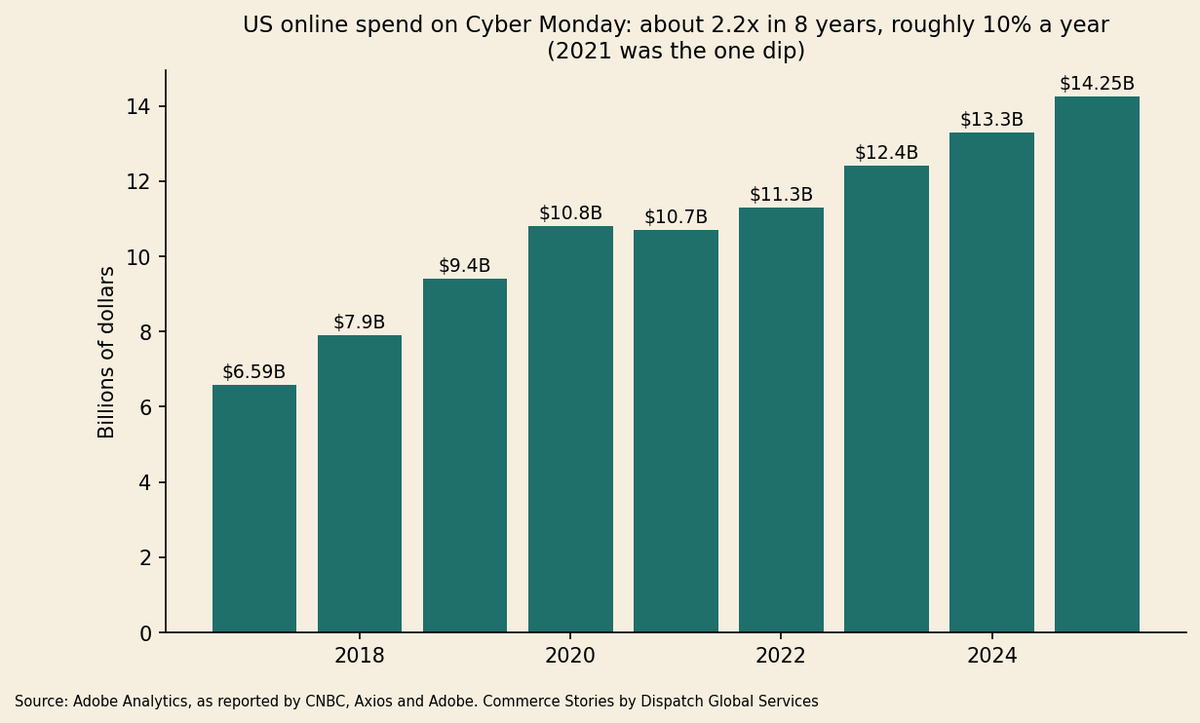
A day invented by a press team is now the biggest online shopping day of the year. Adobe measured $14.25 billion in U.S. online spending on Cyber Monday 2025, up 7.1 percent from a year earlier.
Here is the compounding, using Adobe's yearly Cyber Monday totals:
| Year | U.S. online spend on Cyber Monday |
|---|---|
| 2017 | $6.59 billion |
| 2018 | $7.9 billion |
| 2019 | $9.4 billion |
| 2020 | $10.8 billion |
| 2021 | $10.7 billion (the first decline Adobe had tracked on a major shopping day, down 1.4% per Adobe) |
| 2022 | $11.3 billion |
| 2023 | $12.4 billion |
| 2024 | $13.3 billion |
| 2025 | $14.25 billion |
That is about 2.2 times higher in eight years, or roughly 10 percent a year.
And here is another paradox. The money keeps growing while the crowds do not. The National Retail Federation counted a record 202.9 million shoppers over the five days from Thanksgiving to Cyber Monday in 2025. It beat the previous record of 200.4 million in 2023. But NRF's own survey this year expects 182.7 million. Last year's survey missed its forecast by about 16 million, so the 2026 figure is probably low too. Black Friday remains the most popular shopping day, with 126 million planning to shop. And 59 percent of holiday shoppers say they plan to use AI during Thanksgiving weekend.
Caution: NRF's 2026 release compares 182.7 million to "186.9 million last year," but 186.9 million was the forecast for 2025. The actual 2025 number was 202.9 million, so the expected drop is larger than the release makes it sound. It is a survey projection, not a count.
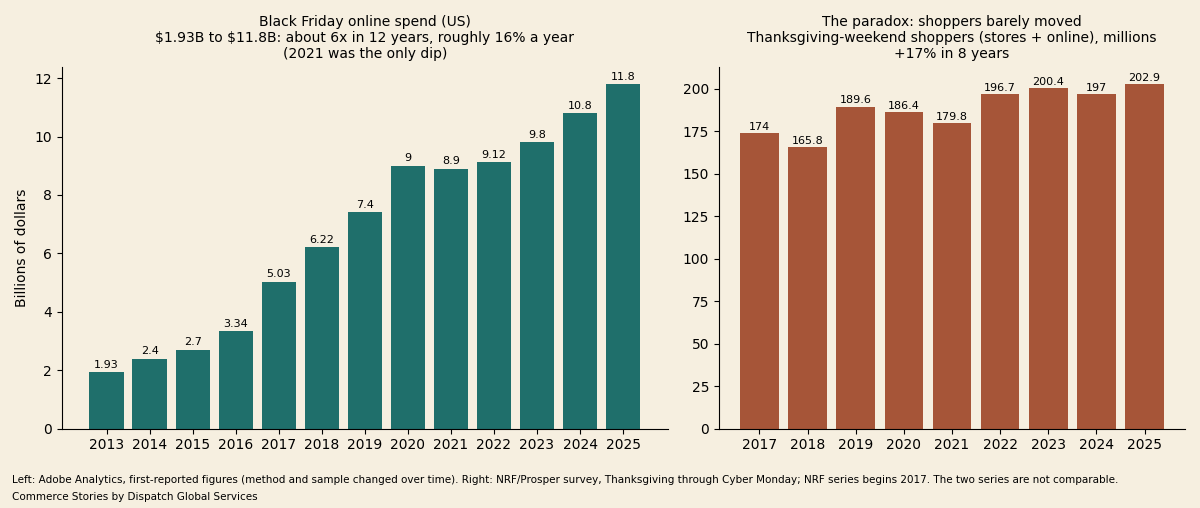
Adobe's online-only count for Black Friday starts in 2013 at $1.93 billion and reaches $11.8 billion in 2025, about 6 times in 12 years, or roughly 16% a year. 2021 is the only year it fell in this series. The shopper count tells a different story: the National Retail Federation's survey of Thanksgiving-weekend shoppers, stores and online, starts in 2017 at 174 million and reaches 202.9 million in 2025, up about 17%. More dollars, from roughly the same crowd. What is not comparable: Adobe tracks online sales only, from a sample of retail sites, and its method and sample changed over the years (it revised 2013 from $1.93 billion to about $1.8 billion in a later report). NRF is a survey of people, not a count of sales, and it its series begins in 2017, so earlier years are not shown. In-store totals have no consistent public series, so we do not chart them.
Part 13. Who gets the credit for the deals? A scorecard
- Black Friday as a shopping day: no one person. A day-after-Thanksgiving habit that grew with the Christmas season, helped by the parades (Gimbels 1920, Macy's immigrant employees 1924).
- The name: no founder. A 1951 factory magazine, then Philadelphia police and two reporters around 1961. The "red to black" story is a later retailer rebrand, and the slave-sale story is false.
- The sale as an event: John Wanamaker, among the first (the 1878 White Sale), with Adam Gimbel among the first to use fixed prices.
- The reason to wait: Edward Filene, with the automatic markdown in 1909 (his Boston basement made the automatic markdown famous).
- Running the floor: Margaret Getchell, credited with Macy's displays, red star and expanded stock.
- The doorbuster and the flash of urgency: the 1965 Kmart blue-light special (the New Yorker's account), with the "door-buster" word in print by 1917 and a good but unproven Wanamaker story.
- The date that gave it its day: Sarah Josepha Hale, for decades of lobbying (36 years by the Park Service's count). Fred Lazarus Jr. lobbied for the earlier 1939 date, and FDR later said it "did not work."
- Sam Walton: not credited with any of it. He built the opposite idea: everyday low price.
Part 14. What deal-makers, and Hale, still teach builders
People are inspired by people. The deal makers here built one small idea at a time, and the widow who gave them their day did the same. What follows is interpretation, not history.
1. Pick one idea that can outlive you. She did not run a hundred campaigns. She ran one for decades. If you publish, build, or sell, ask which single idea you will still be pushing in a decade.
2. Own a platform before you need it. Hale's magazine gave her a place to repeat her case every month. Today a newsletter or a LinkedIn page does the same. When she wrote to Lincoln, she was not a stranger. She was the editor of Godey's.
3. Ask the person who can say yes. After years of building public support, she wrote directly to the one person who could act. She suggested the exact mechanism: a proclamation. Specific asks get specific answers.
4. Expect others to use what you build in ways you did not plan. Hale wanted unity in a civil war. Within 80 years, merchants were lobbying a President over the shopping calendar.
5. Compounding takes the boring middle. The R. H. Macy story and the Hale story share a shape. Four failed stores, then $11.06 on day one. Thirty-six years of letters, then five days to a proclamation. The visible win is the last 1 percent of the timeline.
6. Credit the person who runs the floor. Getchell's name is nearly missing from the Black Friday story, and the stores she helped run are famous. If you lead a team, say who did the work.
7. Check the data. In 1939 a powerful coalition and a President moved a holiday, and the numbers still said it did not help. Measure before you move anything.
Conditions have changed. Hale had the mail and a printing press. You have a feed. Patience and a clear ask are the same.
Tomorrow, and Friday
Tomorrow, millions of Americans will sit at a table on a holiday that Washington first proclaimed, that Lincoln made a yearly habit at the request of a widow from New Hampshire, and that Congress fixed in 1941 after a failed attempt to move it for the sake of shopping.
Friday will bring a day that began as a traffic problem for Philadelphia police, and deals built from fixed prices, white sales, markdown clocks and a flashing blue light. Monday will bring a "cyber" day that a young PR executive named in 2005.
It is easy to find this story cynical. It is really about people who took a small idea seriously, and the many hands that turn an idea into a habit. Start with the deal. Remember the woman who gave it the day, and the one who ran the floor.
Next on Commerce Stories: the life of Sam Walton, and what a man who cut prices every day thinks about a one-day frenzy.
Sources: every date, number and "first" claim in this piece is tied to a source in our claim ledger. Main sources: National Archives (Prologue, "Thanksgiving: Another FDR Experiment"; "Congress Establishes Thanksgiving"), Library of Congress (Hale to Lincoln letter, Sept 28, 1863; Macy's parade guide), National Park Service (Sarah Josepha Hale; Lincoln and Thanksgiving), National Women's History Museum, Pilgrim Hall Museum, Founders Online (Washington proclamation), The Atlantic, The New Yorker, Snopes, HISTORY, Bonnie Taylor-Blake's research, Philadelphia Inquirer archive, Historical Society of Pennsylvania, Smithsonian Magazine, Nantucket Historical Association, New England Historical Society, Encyclopedia of Arkansas, Walmart corporate history, Reuters, New York Times, NRF and Adobe press releases. Checked against these sources November 25, 2026.